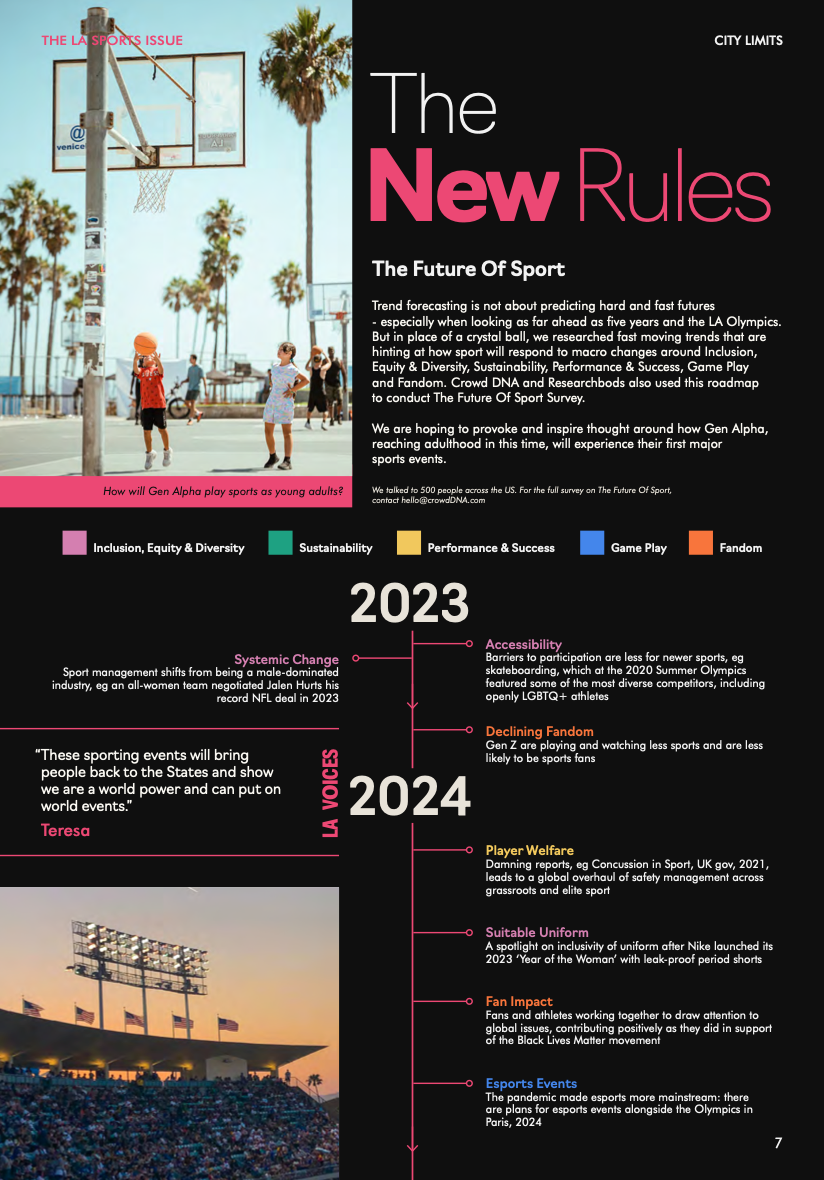
In our latest issue of City Limits we head to Los Angeles as the city prepares to host two of the world’s biggest sports events in the next five years…
For the tenth issue of City Limits – Crowd DNA’s ongoing exploration of the urban experience – we’re exploring sport as another lens to focus on city culture (read previous issues on themes such as mobility and the night economy here). But this time, things are a little different, as we turn our focus onto a single city for once. With the men’s World Cup in 2026 and the Olympic and Paralympic games in 2028 both taking place in LA, the city is uniquely placed to showcase sport today – and forecast how it could look next in our ever-evolving cities.
These are going to be the first global sports events that Gen Alphas experience as young adults, and the world’s entertainment capital will surely know how to get their attention. Our City Limits reports on how preparations are taking place for this, and what it could look like both off-pitch and on…
p5 Semiotic analysis of event logosp3 A roadmap of sport in LAp7-9 The Future Of Sport
The City Limits LA Sports issue combines Crowd DNA’s new research on the Future Of Sport with talking to people on the ground across the city itself, as well as looking at issues like the impact of big events for marginalized urban communities, and brand initiatives during big sports events.
The full 13-page report includes:
_27 emerging trends in sport
_We talked to 500 people across the US for a full survey on the Future Of Sport
_The conversations about sporting events impact on a city and its community
_A semiotic analysis of what event design reveals about action off the field
_LA right now as Angelenos speak up about what matters to them
In our latest issue of City Limits – our regular exploration of changing urban experience – we look at how heritage and change rub up against each other. One of our spotlights was on how Singapore’s hawker food is fighting to survive as well as innovate.
Like many cities in the world, change has never been alien to Singapore. While Singaporeans have become rather desensitised to the speed of change, there’s one thing they are reluctant to see change in at all – and that’s hawker food. What started out in the 1800s as scrappy and unorganised street food sold by migrants, hawker food has since morphed into open-air hubs located at the heart of everyday life. Established hawker centres were built in the 1970s to formalise the cuisine.
Here in the bustling outdoor courts, locals and tourists get good, affordable food. Joining queues for flavorful Singaporean specialities and Michelin-star dishes for under $10 (like the signature noodles with minced pork at Hill Street Tai Hwa Pork Noodle stall) is an unmissable feature of the city’s culture and identity. Hawker food has become part of the furniture – and it’s perhaps unsurprising that Singaporeans tend to be highly protective of it.
Locals and tourists flock to the Hawker centres around Singapore to taste amazing food at everyday prices
But there’s been a real fear in recent years that hawker food is on the brink of disappearing due to factors like an ageing population, unattractive working conditions and the pandemic. The 2020 UNESCO inscription (that commits Singapore to protecting and promoting it to future generations) was thought to be a lifeline to the trade, but some argue this was a red-herring route to go down. While nostalgia is a strong driver behind the survival of traditions, the fixation with the past can sometimes do more harm than good.
In the case of hawker food, we can see that nostalgia is laced with complex socio-cultural expectations and generational differences. It traps Singapore’s hawker food in the past and threatens its future.
“Omg, my chicken rice is now 20 cents more.”
Hawker food is expected to never cross the invisible boundaries of class. Low prices over the decades have created an ingrained perception that it’s less ‘atas’ (Singlish for sophisticated and high class) and should always remain so. Increases in prices can create a feeling that it might be more ‘worth it’ to eat at a restaurant (ironic as most hawker dishes today still come under $6 while restaurants and international franchises are $15-25). Social expectation around price severely hampers its survival amidst inflation, with the immense challenge of being forced to remain ‘low class’ with low prices while maintaining a profit.
TikTok creators champion Singapore’s hawker food stalls with both celebratory videos and content to highlight the issues that are facing the chefs to survive in today’s tough economy
“This one doesn’t taste original.”
Apart from price, there’s also an expectation for hawker food to remain unchanged in form and flavour to live up to the concept of ‘authenticity’ – as if it’s a timeless artefact. Changes in operation – from simplifying preparation methods to handing down to ‘the kid’ – are often met with uncertainty, cynicism and fear that the ‘authentic flavour’ will be lost. Meanwhile, younger hawkers who choose to venture out (eg with fusion food) receive little recognition as a part of the city’s hawker culture simply because they are not ‘traditional’. Again, the intense nostalgia surrounding hawker culture is preventing any type of innovation.
So what’s the way forward for Singapore’s hawkers stuck in a nostalgia trap? Of course, nostalgia is still crucial to the survival of traditions. But in the case of hawker food, it has made definitions too narrow to accommodate new joiners into the scene. This in turn threatens preservation. Cities change, tastes change. Accepting this will keep hawkers filling our bellies for decades to come.
In our latest issue of City Limits – our regular exploration of changing urban experience – we look at solutions to world problems in the food business – from climate labels on menus to floating farms. One of our spotlights on sustainability is the rise of the zero-waste restaurant as not only a call to action, but an immersive experience for the diner.
Cities around the world are full of immersive dining experiences. From eating dinner in a makeshift aircraft, to sipping cocktails in the cupboard of a pawn-shop; going out for a meal is no longer just about the food. For those looking beyond standard dining experiences, meals are accompanied by a spectacle. So much so that experience fatigue has set in.
So where do you turn when all the ‘experiences’ have been had? When you’re served yet another once-in-a-lifetime theatre show while trying to eat your soup? You turn back to the real hero: the food. Forward-thinking restaurants in global cities are shunning the temptation for distracting entertainment, and letting the food become the experience again.
The reusable coffee container and the composter taking pride of place in the dining room at Nolla (photos by Nikola Tomevski)
Enter the zero-waste restaurants: establishments attempting to do away with food waste entirely. Here, the food becomes the focus as diners buy into the admirable attempt at fully sustainable dining. While the issue of waste is certainly not a recent obsession for the restaurant industry – lots of places have been experimenting with sustainability for decades – what’s new is the front and centering of the efforts, and the glamorisation that goes with it.
Silo in London, for example, is designed ‘back to front’ with the bin in mind (irony being they don’t actually have a bin, they don’t need one). All food is used in its entirety – think cured mushroom stems and yeast treacle. Any leftovers are composted and sent back to their hyperlocal suppliers. Like Silo, Helsinki’s Nolla (‘zero’ in Finnish) sends compost back into the system, but guests are welcome to take home a scoopful too – a different kind of doggy bag. It’s philosophy of ‘refuse, reduce, reuse, and only as a last resource, recycle’ is consistent, from a reusable coffee container and a composter (above) to not accepting food that comes in single use plastic.
Meanwhile, Mume in Taipei has a dedicated sourcing manager (rare in a small, Asian restaurant) with the mission to champion underrated Taiwanese ingredients and zero-waste cooking practices.
A lampshade made out of seaweed and paper waste by Tŷ Syml at Silo (@silolondon) and taking ‘zero-waste’ centre stage at Rhodora (@rhodora_wine_bar)
These places strive to avoid food leftovers, but also any scrap of rubbish. Rhodora in Brooklyn – a fully sustainable wine bar also ‘waging a war against waste’ – shreds wine boxes into compost material and donates corks to an organisation that turns them into shoes. Everything is transported on bikes. Back at Silo, plates are made from plastic bags, wall lights from crushed bottles, and ceiling fixtures from dried seaweed. This all-in approach to the zero-waste concept is what makes these restaurants a fully immersive dining experience – no gimmick-y entertainment required.
But these restaurants aren’t cheap: they’re all mid to high-end. This is interesting for two reasons. Firstly, sustainability is definitely something to be coveted, but why is the experience of it not more accessible? Secondly, could the price points actually work in sustainability’s favour? Making zero-waste dining a sexy, high-end experience brands the concept as an aspirational lifestyle. Like the Tesla car model, fancy zero-waste restaurants could, in turn, make the thought of intensive recycling more desirable – eggshell compost and all.
Saying that, it is a bit odd to glamorise something that should be an everyday activity. If people are playing at sustainability when they dine out, are they less likely to practise it at home? The very act of going out for a meal that has been beautifully prepared for you distances it – managing food waste becomes something to passively experience and admire, rather than actively do.
Either way, city diners are hungry for new, immersive experiences – and zero-waste restaurants are a welcome addition to the menu.
Our relationship with food doesn’t only reflect our culture, it also helps to define it. In our latest issue of City Limits we invite you to enjoy our appetizers and insightful mains on city food…
We’ve seen so much in our City Limits series – Crowd DNA’s ongoing exploration of the urban experience – since it began in 2018. Over five years, it is our opportunity to bring together thoughtful reporting of what is happening now in cities and forecast how it could look next in compelling sectors like city living, youth culture, and mobility, to city-centric solutions and the night economy.
We’re now back with our ninth issue and to ask what’s happening in the food and drink business in cities around the world after a challenging few years. It explores how what we eat and drink impacts on a city’s culture, ways that urban plays its part in a product’s story, and how food is such a pleasurable taste of change as it happens in our ever-evolving cities.
Pg4 Kaiseki 2.0Pg3 Wish You At Here mapPg5 Diaspora Dining
We go to restaurants in Tokyo where Kaiseki fine dining means fun and frivolity, find out why Singapore’s hawker food culture is being harmed by nostalgia, enjoy slow moving cuisine in London, and taste when food gives community to the diaspora in cities around the world – and ultimately, to us all.
The full 17 page magazine includes:
_A semiotic analysis of how city sights and sounds are used by three food brands – even when made elsewhere
_Spotlight on whatwe drink reveals about a city culture
_How things are getting better (or at least not worse) with problems facing our food environments
_Five emerging trends in urban food
_Interviews with local business people, with learnings for grassroots engagement in towns