Our global Crowd Numbers team on how to make waves with a game-changing business segmentation…

Successful segmentations are transformative. They become part of the DNA of an organisation, inspiring a shared feeling of ‘these are our customers’ that everyone – from product, to marketing, to the C-suite – can visualise and respond to. They’re also a quintessential form of quantitative research. And, if done well, can provide a robust yet nuanced understanding of people, not just profiles. 

All too often, however, the hard work that goes into a segmentation falls victim to reports overloaded with data; pen portraits with zero personality, and disengaged stakeholders. Getting them right is both an art and a science. Here, our global Crowd Numbers team sums up how to build a segmentation guaranteed to have impact.


1. Segmentations without cultural context aren’t going to change the world (or your brand)

Segmentations can sometimes feel sterile and devoid of any of the context that surrounds the segment profiles. This can lead to an exclusion of nuance that ultimately influences consumer behaviour. At Crowd, we combine cultural understanding and quantitative analytics to bring customers to life. When designing segmentations, we take into account current trends, cultural shifts and data from different sources to replicate the real world thinking and experiences of the people behind the numbers.


2. Avoiding death by data-overload will win you fans

Data overload is an all too common problem when faced with a segmentation. At the heart of the numbers are real people, so our goal is to enhance understanding of them and their lives by reducing the data-induced noise – not adding to it. We aim to demystify the numbers as much as possible by simplifying them (with easy to understand language, and an appreciation that not all data points are worth including), and making the segment information accessible to everyone across the business.


3. A segmentation lives or dies by how it’s socialised

Linked to data-overload is the fact that segmentations are only useful if they lead to meaningful action – aka whether they’re used or not. One of the best ways to achieve action is to breathe life into the segments so they become easier to empathise with. Our in-house Socialise team creates outputs that land a segmentation in the most impactful way for organisations. Whether it’s profile videos, one-pagers, editorialised zines or stakeholder workshops, we ensure the segmentation lives on long after the project wraps up.


4. The trick to coming up with something solid is to keep things flexible

As contradictory as it might sound, a robust segmentation is built on a bed of flexibility. There’s no such thing as an off-the-shelf approach when it comes to our segmentations. We recognise that needs and priorities can evolve over the course of a project. Having the freedom to adapt means we can overcome challenges and create an approach that works for everyone. Need more time to perfect the questionnaire? No problem. Want to explore the different segment solutions before committing to a final output? We actively encourage it.


5. Successful segmentations require constant collaboration  

From the beginning, we aim to become an extension of a client’s team. Joining up our thinking at every stage means the segmentation will be crafted from both a research and business perspective. Kicking things off with a stakeholder workshop ensures we design the project from the ground up. We then work with clients every step of the way, driving engagement and inspiring the business at key moments. Crucially, defining segment profiles is a key piece of the puzzle and one which we believe should be done together.


6. Don’t forget to think outside the box

Lastly, segmentations are both an art and a science. While there are some general ground rules, challenging the status quo is always worth it. We don’t rip up the rule book each time, rather look for ways to enhance tried and tested methods with creative thinking. Working with our STRAT7 partners, Bonamy Finch, we combine the latest in data analytics with our research expertise to create data-driven and relevant segmentations, all with the aim of driving culturally charged commercial advantage for our clients.


If you’d like to hear more of our thoughts on segmentations, please get in touch: hello@crowdDNA.com

Collaborative Cities

Cities don’t need to feel devoid of empathy. Crowd’s Olivia Anderson explores how safe and inclusive urban spaces begin with building for women

Urban mobility specialist Mónica Araya was recharging her electric car in a remote part of Norway when she had a thought: she wouldn’t have felt safe there without her husband. But while much thinking about the female experience of cities is rooted in functional-spatial concerns around safety, she acknowledged it can be taken so much further. 

“We will find that in the next 10-20 years more women will be running cities, which leads me to think; will this look macho or female and will it feel and look like a city that has new elements coming from women?

Mónica Araya 

While streetlights and street-facing windows can mitigate the problem of women’s safety, they aren’t completely solving it. We can consider what happens when you take values traditionally associated with femininity – kindness, sensitivity, co-operation – and use them to shape a city. How embedding a different value system could be the catalyst for impactful cultural shifts. And how to plan a city through the prism of the female experience can make space for values like inclusivity and empathy.

For example, cities can take into account a more modular mode of living with decentralised hubs and flexible, multi-functional spaces that make it easier for women to access all parts of the city. In 2020, mayor of Paris Anne Hidalgo led on this with her hyper-local vision for the 15-minute city: urban planning so that people live, work and have access to all the services they need — whether that’s shops, schools, theatres or medical care — within a 15-minute walk or bike ride. 

The drive to prioritise accessibility in urban design can also be seen in the creation of inclusive spaces; Geneva uses female figures in road signs, and Vienna features LGBT couples in traffic lights. These simple acts legitimise the presence of women, and other marginalised groups. And here we see how attitudinal shifts can often follow these concrete planning initiatives – in this case, tolerance.

Meanwhile, ensuring diverse representation in urban planning at the different stages of development is a way to also avoid oversights that make cities inaccessible for women; for example, planners in Barcelona identified that the public restrooms couldn’t accommodate prams. In Amsterdam, there was a public outcry around the lack of sanitary facilities for women. Conversely, Edmonton in Canada supplies free period products in every public restroom. This kind of provision has the power to drive inclusion. 

Most persuasive for a collaborative city is knowing that if you get gender right, it can build empathy and emotional intelligence into the DNA of a city – making space for those to whom cities have historically been inhospitable. Improvements like more rest areas for people with disabilities, or better lighting, and facilitating access to all the things a city has to offer signifies that the city is for everyone. 

The social implications of empathic infrastructure have the potential to be far-reaching and to effect a more equitable urban environment. After all, our spaces define us as much as we define them. 

To read more about spotlighting safety measures for women our City Limits: Solutions here.

City Nights: Lagos

Our KIN network takes us on a trip to their home cities. First up, we join creative entrepreneur Toye Sokunbi on the Lagos party scene…

Toye is a creative entrepreneur and founder of ARTISH, a Lagos-based human resource start-up for creator economy freelancers. We asked him to take us on a tour of Lagos after nightfall.

“The night is like a balm to the severity of the day. Extreme affluence side by side with poverty; harsh conditions; mile-long traffic on failing infrastructure – there’s a lot to contend with during the day in Lagos.

But, at night time, there’s a calmness that overcomes the struggle.

Difficulties are washed over by a kaleidoscope of streetlights, silhouettes and the ocean stretching out from the shores of the city.

Everything seems to stop in a moment in time. Even a packed club with bass pumping from the speakers feels like a reprieve…”

Toye shares his best nights in Lagos. Find out more about the Crowd DNA KIN network here.

There ain’t no party like a Lagos party

Lagos’ biggest party season is in December, and a frenetic series of mixers, exhibitions, weddings, birthdays, house parties, concerts, music festivals, club nights and more that begin in the last days of November stretching through December, and sometimes bleeding into the early weeks of the new year. ‘Detty December’ as it’s fondly called by Lagosians has gained global infamy in recent years as a seasonal destination for hedonist debauchery and cheap but tasteful fun.

Now ‘Detty Easter’

A growing number of events are packing out Easter holiday weekends. Though relatively milder compared to the Detty December, it’s not unusual for big UK and US artists to have headline concerts in Lagos during Easter, or for Nigerians in diaspora and holidayers from around the world to party in Lagos for a few days during Easter. With reduced flight costs in April, and the mellower pace, Detty Easter is a budget-friendly Detty December.

Budget Lagos nights

Clubbing is not cheap anywhere in the world, and Lagos is no different. Recently though, the demand for pocket-friendly alternatives has become an opportunity for party promoters to host electronic music-themed, events. Though the frequency of EDM events is still limited to monthly and bi-monthly ticketed parties and festivals, the community is growing because it gives the underserved budget clubbers an experience of what a good Lagos night should actually be: a progressive safe space to enjoy good music with friends without having to break the bank. Element House is a monthly house music party often hosted in Lagos by Spektrum Live and attracts DJs from around the world. Similar events are hosted by  independent promoters are Sweat It Out Lagos, EkoLectro, House On The Reef and more.

Alt-Nightlife Lagos

Elaborate Escape Rooms, game nights, arcades, silent parties, play-listing parties and themed-private dining, are only a few of the new innovative alt-nightlife activities that have grown in popularity around Lagos since the end of the pandemic. 

Bature, an outdoor craft beer spot set in Victoria Island, for example, offers a touch of indigenousness and authenticity on its drink menu. Beezus Kitchen, a catering company based in Ikoyi also hosts a monthly ticketed 8-course private-dining event called K-BBQ Night, which — as the name implies — is a Korean-themed dinner menu for a select number of guests. Last year, Wafflesncrm, a Lagos-based skate brand celebrated its 10th anniversary with a skate-themed concert, featuring indoor ramp skating side-by-side music performances and DJ sets. The goal for many of these themed spots and events is to give nightlifers unique experiences that cannot be easily replicated.

A lot of Nigerians unwind by partying

The way Nigerians let their hair down is changing with younger generations and the advent of social media. While it’s largely still confined to red light district subculture, the adult entertainment industry is growing in popularity and becoming a subject of fascination, among working class urban men and women alike. Over the years there’s been more open curiosity and less stigma around experimentation with drugs, too. Nigerians are quite laid back people, generally speaking – but nowhere parties like Lagos!

To delve into more city life read City Limits, our series of pieces exploring the urban experience here.

Captions As Content

We spoke to the Crowd team about how captions connect people, develop global citizenship, and have a big impact in just 50 characters...

Twitter has demanded we distil our thoughts down to 280 characters. But the real mastery of language these days is being shown on captions. The caption – ideally 1-50 characters – may be taxingly short, but once mastered, it is a content device with multiple compelling uses and opportunities. 

In a time when the caption plays such a big role in streaming, social media and gaming, a text version of short dialog or sound effects is very important. Of course, it makes popular content more accessible for the deaf or hard of hearing. But it is also influencing culture on a global scale. The care and diligence the subtitler takes on streaming TV content for all the various languages, for example, can make all the difference to authenticity for the audience.

We’re also seeing how captions are changing behaviour: teenagers prefer to watch their shows with subtitles on (four out of five viewers aged 18-25 use subtitles all or part of the time, Stagetext, 2021), while it’s captions-as-convo on gaming platforms like Roblox. But what are the challenges and rewards of using captions in content?

Getting translations right could give global content platforms a competitive edge. Crowd DNA’s Jennifer Simon (associate director, semiotics), describes captions as “a powerful tool of communication” but warns: “Captions are often overlooked.”

She says: “Unsurprisingly, they are often seen as neutral labels – but they are anything but. They communicate a host of hidden, culturally specific meanings.”

For example, when Korean drama Squid Game was released, native Korean speakers pointed out that both the English dubs and subtitles for Squid Game were inaccurate – and communicated different cultural meanings. “As we can see here, the meanings of captions depend heavily on our cultural context – ultimately influencing how we interpret and understand the intended message.” 

Meanwhile, we rely more and more on captions to perform our own lives – and comprehend others. Reading captions helps us with a basic need of our time: it aids multi-screen use.

Rachel Rapp (director, futures), says: “Captions are playing a huge role in our multi-screen lives.”

She explains: “Captions are everywhere and now allow us to watch a reel at the same time as a TV series. A meme we’re enjoying is usually summarised in the text overlayed so that our short attention spans can grasp the joke fast – without distracting us from our work, or the episode we’re stuck into. We caption every picture we post.”

Captions also allow us to embrace our growing global citizenship. Now that captions are on so much of our media, reading them is no longer seen as hard work. This influences the success of international dramas as we’ve seen with Squid Game (Korean) or Money Heist (Spanish). And this exposure to international content helps our growing global citizenship.

And finally, it’s also another tool in the kit for the creator community. Chloe Swayne (senior designer, Socialise) says: “The ways in which we see captions being used both as a visual aid and a visual device are evolving – most rapidly within social media. Essentially handing captioning control over to the creator has enabled us to create a whole new visual language – on how words and pictures ought to interact.”

For brands and content producers there’s a lot to think about when it comes to captions. But let’s end this short-ish conversation acknowledging that the art of keeping things neat and to the point has always been a sweet spot in content. And with captions – and mastery of 1-50 characters – that’s now more than ever.  


Cultural strategy executive Jasmine Lo reflects on her time spent during Crowd's Culture Club internship programme…

The start of a new year is always a good time to process experiences and jot down any learnings for the year ahead. Last summer, I joined Crowd’s Culture Club programme as a cultural strategy intern. The experience was a whirlwind in the best way possible. With time to reflect on it since becoming a permanent member of the team, I thought I’d write a bit of a note to self and share some things I’ve taken with me from the journey. 

1. Trust in the process of figuring it out

It is rarely a straight line to landing the right role and company. It certainly took me a while before I found Crowd. I don’t think I’ve ever completed an internship that felt as fulfilling as Culture Club. Being thrown straight in as a newbie is terrifying, but it’s the most effective way to learn, and Crowd has you shape-shifting and figuring it out from the get go.

2. There are so many ways in

It is always eye-opening to learn all the ways folks at Crowd made their way to the company. A non-linear career of funky job pivots or travelling across countries through the years is something we are united by. With such an array of experiences across industries and cultures, it’s no wonder Crowd does things a little differently. 

3. Confusion became my best pal, so, I will let it ground me

I have never been so pleased to have no idea what was going on than here at Crowd. Culture Club armed me with the openness to keep asking myself and others questions along the way. Every day was (and still is) totally different and it forces you to ask questions. Before joining Crowd, I had rarely seen research done with such creativity and empathy. The process itself is a source of endless inspiration.

4. Solidarity and support come in so many forms at Crowd

Who knows where little conversations here and there can lead to. One of the best pieces of advice I got when I first joined was: “it’s not about doing the most in order to prove yourself – that’s not what we’re about at Crowd – it’s about tuning in and being really present and talking to others”. As a newbie, that was invaluable to me. There is always someone at Crowd I feel able to reach out to and that’s really special and important to hold onto.

5. My cross-cultural chaos matters

This is cultural strategy after all. The more cultural nuance the better. I need to trust in the things I do know because they help me navigate a lot of what cultural strategy is. Our individual intuition to navigate conversations is everything. 

I’ve now joined the strategic insights team permanently, but I will always look back on my early months at Crowd with fondness. Culture Club is a prime example of what an internship should feel like – you should be able to walk away and into whatever role is next for you confident in the possibilities ahead. 

Curious about the Culture Club internship programme? Read all about it here.

The Metaverse In Numbers

As part of our debunking-the-metaverse series, we look at the big, small and out of this world numbers in its evolution…

As with any developing platform, there’s a lot of smoke and mirrors going on in the metaverse – some of which we’ve tried to clear a way through in this debunking series. We can also look at the numbers – the good, the bad and the salutary – and what they tell us about how the metaverse is being met by businesses, brands, consumers and communities today. So here are the numbers that reveal the now, next, and not ever of the metaverse.

The metaverse is older than you think… 

30 years

The word ‘metaverse’ was coined in the novel Snow Crash by Neal Stephenson in 1992. The metaverse was an online refuge from the dystopian meatspace.

…but it could come about quickly 

25%

The percentage of people who will spend one hour a day in the metaverse for work, shopping, education, social, and/or entertainment by 2026 (Gartner, Inc).

How much? 

$13 trillion per year

The revenue that Citi and KPMG state the metaverse could generate by 2030. 

Metaverse platforms are bringing in the big bucks

$650,000 yacht

A luxury yacht with two helipads, several lounge areas, a jacuzzi and a DJ booth, sold as part of an exclusive luxury series developed for Sandbox (one of the largest gaming platforms). 

$4.3 million real estate 

On November 30 2021, metaverse investment company Republic Realm paid $4.3 million for land in The Sandbox metaverse to add to its 2,500 plots of digital land across 19 virtual worlds.

100 million log-ins

Nearly a hundred million people a day log onto Roblox, Minecraft, and Fortnite Creative platforms. 

Tech business is getting a slice of the meta-pie

1,100 regulatory filings

The US Securities And Exchange Commission reports that in the first six months of 2022, the word ‘metaverse’ appeared in regulatory filings more than 1,100 times. The previous year saw 260 mentions. 

$10 billion lost

In October 2021, Facebook changed its name to Meta and it now loses more than $10 billion each year on its metaverse initiatives.

$70 billion

In January, Microsoft announced the largest acquisition in Big Tech history, paying $70 billion for gaming giant Activision Blizzard, which would “provide building blocks for the metaverse.”

Culture has exploded into the metaverse

£10 million

The estimated value of paintings burned by artist Damien Hirst after 5,149 buyers chose instead to have an NFT of the artwork from his latest collection – aptly titled ‘The Commerce’. It is the most exciting project I have ever worked on by far,” says Hirst.

But there’s still a (very) long way to go…  

38

The very low number of “active users” in the community of Decentraland (DappRadar)

This blog is based on our recent Crowd DNA Amsterdam webinar, which you can read here and watch in full here

Next in our debunking-metaverse-myths series, we look at how to predict where it's going next… 

The metaverse is currently swamped by a lot of over-commercialised fast culture (see our previous post). To really understand the direction of the metaverse, we need to interrogate the real world – where real people with real problems live – by looking at slow culture. 

To recap: fast culture is made up of areas of society that change at pace, like food trends; slow culture is formed by areas that evolve over much slower periods of time, like family and work. The metaverse’s future doesn’t lie in gimmicky brand activations. It’s within slow culture that the real clues can be found. 

Crowd Signals 

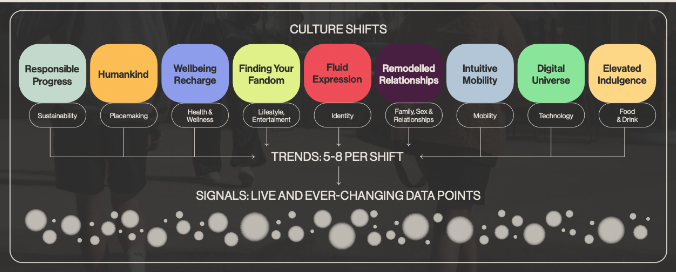
At Crowd DNA, we work with nine cultural shifts that are at the foundation of societal and cultural change (see image below). We’ve devised these via our Crowd Signals hub, inspecting social data points to predict trends that ladder up to them. By using these shifts and translating them into a digital future, we can get a glimpse of the metaverse ahead.

Crowd Signals is structured around a bespoke taxonomy of nine fundamentals of modern life, each evidencing a cultural shift.

Responsible Progress – Decentralised Fashion

There have been huge changes within the fashion industry over the past few years. Many of these have been as a result of its dark relationship with environmental waste, pollution and social injustice. Sustainable clothing is now available up and down the high street, and reusable or shared products are helping fight the war against fast fashion. 

But how is sustainable fashion playing out in the metaverse? Forward thinking businesses – such as digital fashion house, The Fabricant – are building decentralised platforms that give consumers control over their own designs and output. So, instead of producing physical samples, people can research and develop their own ideas in the metaverse – reducing environmental strain on garment creation in the process. This also puts more power into the hands of consumers, challenging fashion’s hierarchical structure in the process. 

The metaverse has enormous potential to research, design and test environmentally friendly methods of production. We’ll be able to try on clothing in virtual changing rooms, design our own digital samples and discover new community generated looks – all crucial in the attempt to slow down fashion and democratise the creative space once and for all. 

Wellbeing Recharge – Optimised And Ownable Health

Global uncertainty has forced people to tune into their mental, physical and social health more than ever before. New systems of care are emerging in response. The emphasis being on systems that integrate data and individual preferences, designed to empower us to take charge and become more conscious of our own health. 

Translated into the metaverse, digital healthcare has lots of possibilities. Virtual clinics are being set up to combat geographical barriers to healthcare. A specialist can be stationed anywhere in the world, but still be able to view a patient’s scans and tests done at local facilities. While this responds to healthcare’s accessibility, digital twins are paving the way for more holistic and user-centric treatment plans. Q Bio Gemini, for example, uses patient data to create simulations of anatomy. These twins can then be shared with medical professionals, giving them a live, always-on window into a patient’s health. People will also be able to see – and ‘own’ – their own health status, as well as receive more personalised treatment plans. It seems that healthcare in the metaverse could empower people to take charge of their own wellbeing and measure it in the most complete sense.

As we can see, the metaverse is unlikely to remain as a playground for virtual yacht parties and celebrity avatars. The more we inspect slow culture, the more we can see what it will be. That is, a world powered by real humans with real human needs ­– who are not driven by consuming NFTs or eating digital burgers (or at least, not all the time). 

This blog is based on our recent Crowd DNA Amsterdam webinar, which you can read here and watch in full here

Roughly 14 years and five months in the making, finally we've got round to writing our book. How We Work With Culture tells our story - the important stuff and the weird bits and pieces. But why bother? CEO and founder Andy Crysell explains...

First up, an admission. Probably should’ve written this a long time ago. Not now, almost 15 years into the Crowd DNA story.

So why now? Well, better late than never. Also because, as we grow, as we become more global, communicating what we stand for becomes ever more important to get right. We can’t just hope that this will all drift through the ether, like we perhaps could when Crowd DNA was a handful of people sitting around the same table. Now we’re not even sitting in the same timezone.

Prior to creating How We Work With Culture, what’s in here had never all been put down on paper in the one place. It had been talked about in instalments. Shared in various presentations, workshops and company get-togethers. It had existed in the heads of various people (much of it in mine). It often ended up hidden away in the mysterious depths of our Google Drive.

What do we hope to achieve with this? To give our team, particularly new arrivals, a stronger sense of what we’re about. The confidence to dive into the wonderful messiness of working with culture. And if there are people outside of the business who are also interested in what we’re about, that’s great, too.

We hope it will demonstrate that, despite all of the aforementioned messiness, Crowd DNA has craft to it – something we can call… a way. We want to be seen as a unique proposition, and to define and inspire a next generation of cultural strategists. We think How We Work With Culture has a big role to play here, too.

But then in some ways it’s just nice to have the opportunity to tell our story. All of the things we chat about. The stuff we try to make sense of, and somewhat obsess over. The big strategic things, but then also all of the weird bits and pieces that make up our narrative. All of it, in its own way, is important.

With thanks to the entire Crowd DNA team, whose creativity and energy never fails to amaze. Special applause for Chloe Swayne for all of the fabulous design work (and perseverance) that went into creating How We Work With Culture. And to our group managing director, Dr Matilda Andersson, for her contributions here, but more so, for her commitment to Crowd DNA itself.

Andy Crysell, founder and CEO