Tell me more. Picture the scene: you’re bored of performatively reading Sylvia Plath at Jolene cafe. You want to take your carefully cultivated Reader Aesthetic to the next level, but you aren’t sure how. Enter luxury fashion houses. 

Word on the street is ‘book girl summer’ … It’s so much more than that. Literature is becoming a lifestyle, and one that is distinctly aspirational. Valentino really got the ball rolling with their SS24 collection using Hanya Yanagihara’s acclaimed novel A Little Life as a conduit to explore new meanings and expressions of masculinity. And Thom Browne’s NYFW show in February of this year drew inspiration from Edgar Allan Poe, because goths are important too. 

So it’s the luxury version of dressing up for World Book Day? It goes a little deeper than that. Miu Miu’s Summer Reads initiative sees the brand gifting copies of seminal novels – all written by women – to visitors at pop-up locations around the world. Maison Valentino even sponsored the Man Booker Prize this year. Chanel’s 7L bookstore in Paris is now host to an arts programme designed to cultivate creativity and foster appreciation of the arts. While Aesop is getting in on the action too with its Women’s Libraries, using A Tale of Two Cities as the theme of its Women’s Day activations in China and dedicating its stores to novels written by or foregrounding women. Brands are using literature as a vehicle for something deeper than dress-up.  

It’s all very Dead Poets Society. It’s not just for the Dark Academics amongst us – Audi recently released Handbook Novels, where they partnered with up-and-coming authors in Spain to write novellas featuring key words from the cars’ instruction manuals in a bid to get people to actually read their instruction manuals. 

Rise up, English teachers. Pretty much. In the same way that luxury brands like Burberry and LVMH started producing PPE and hand sanitiser during COVID, we’re seeing this reverence of literature bubble up at a time when creativity is under threat, when “truth” is no longer an absolute, when the maelstrom of the online world makes it hard to distinguish signals from noise. It makes sense that brands are turning back to what feels time-honoured, certain and lasting – what culture writer Nadja Sayej calls “the timeless wisdom that can be sought if we put down our phones”. And fashion and literature are natural bedfellows – it’s all about cultural commentary and storytelling, be it pen and paper or needle and thread. 

Wicked smart. The message is clear: literature is a still point in a turning world, and one that is being called on now more than ever. Close enough to describe our realities, far enough removed to allow us to examine them through the trusted lens of cultural artefacts that have stood the test of time. 

TL;DR: literature is hot vital. Brands looking to cultivate credibility and foster ideas should lean on literature – particularly the certainty that the classics offer – as a north star and a source of inspiration in a world freighted with opposing cultural forces. 

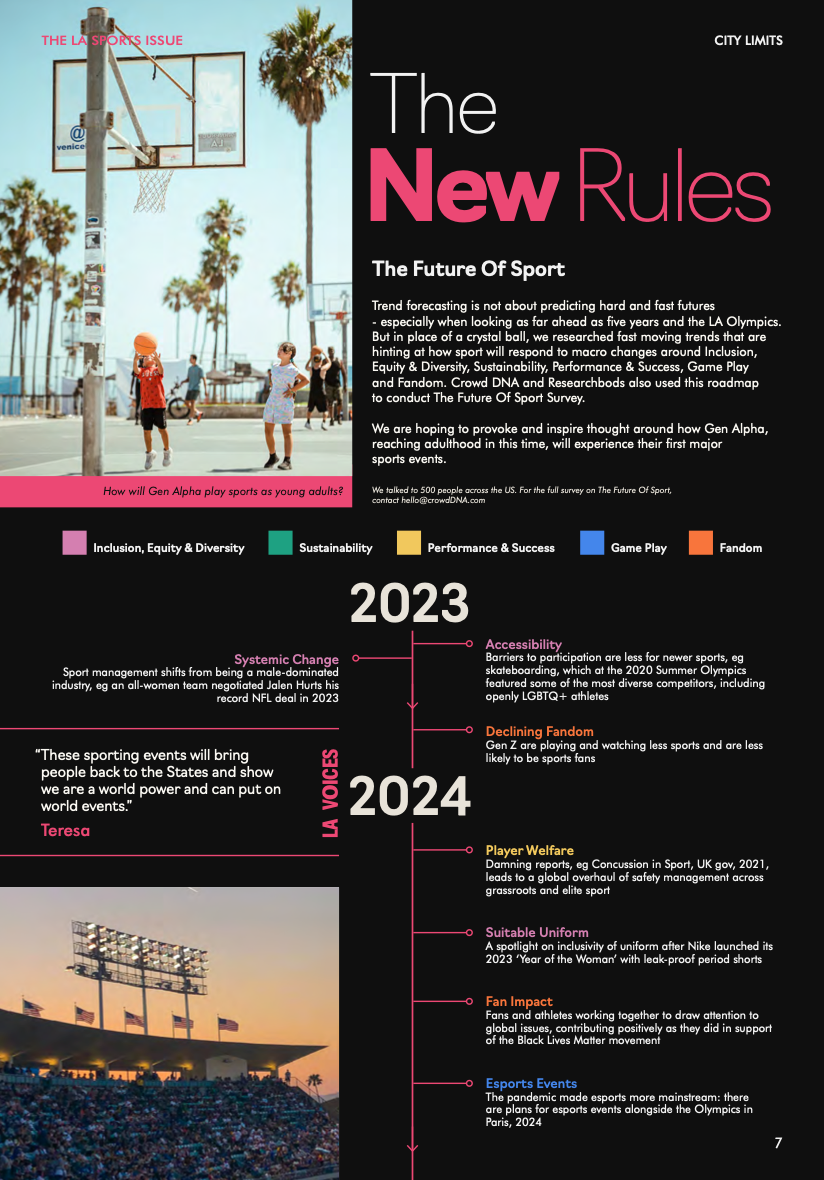
The New Rules

Sport is at its best when it is inspiring us, and we found plenty to be inspired by in our Future Of Sport Survey. We wanted to find out how sports has the power to challenge attitudes around the major forces of Inclusion, Equity & Diversity, Sustainability, Performance & Success, Game Play and Fandom. We used these cultural shifts as a roadmap to what sports might look like for tomorrow’s players and fans.  

For the full survey on The Future Of Sport, contact hello@crowdDNA.com 


In this survey, we got to interesting provocations around:  

Inclusion, Equity & Diversity 

Traditional barriers are being challenged (such as improved equity in sports, whether financial, gender or physical access), and questions about inclusion (especially for non-binary or trans people in sport) and the relationship between sports and politics are under scrutiny. 

We found that…  

96% of Americans agree it’s important to make everyone feel welcome within the sports community 

50% of Americans agree that sportswashing is a problem 

96% of Americans agree it’s important to make sports accessible to everyone


Sustainability  

New solutions are being found to create more climate positive events, for example FIFA has committed to net-zero emission by 2040; and Formula 1 has a strategy to become a net zero carbon sport by 2030. 

We found that… 

87% of Americans feel it is important to reduce the carbon footprint of sporting events and experiences  

37%  of Americans feel the transparency from sporting organisations and events around global issues such as their sustainable impact will improve in the next five years  


Performance & Success 

As athletes like Simone Biles and Naomi Osaka withdraw from events to prioritise their mental health, it’s no longer success at any cost.  

We found that…

68% of Americans agree that the mental wellbeing of athletes is more important than their performance 

72% of Americans agree that athletes achievements are rooted in their story off the field, not just what they do on the field

96% of Americans agree it’s important that new technology is developed to protect the physical wellbeing of athletes 


Game Play  

With eSports eventing firmly established, other challengers to traditional sports play includes the rise of player-driven organisations, and a bigger spotlight on player welfare. 

We found that…

20% of sports fans would consider watching eSports in the future 

51% of Americans agree that biohacking will become more prevalent in sports 

64% of Americans feel the use of technology while watching live sporting events will improve over the next five years 


Fandom 

People are changing how they watch sports, turning to creators and technology that builds the personality and profile of players online, while teams are meeting fans where they are most vocal: in Twitch streams, Roblox arenas, TikTok, and Twitter threads.

We found that…

69% of American females identify as sports fan, compared to 81% of American males 

56% of Americans (61% of sports fans) have engaged with athletes or teams outside of the sport, eg on social media, live streams, or listening to a podcast 


For the full survey on The Future Of Sport, contact hello@crowdDNA.com 

Club Free Issue One, download it here.

At Crowd, we believe that change presents opportunity.  

Our latest editorial insights series, Club Free, is about groups seeking a new way of thinking about their individual liberty. It’s not freedom that’s unchecked or selfish: we talked to people who are providing each other with the support, empathy and community to exercise their freedom effectively.  

In chapter one: The Poly-Normals, we heard from married couples, young daters, content creators and community spokespeople in the US and UK who by choosing to engage in multiple romantic relationships make room for more creativity, more sharing and more openness. 

Here we dig a little deeper into this relationship energy and identify how fringe movements like polyamory can inspire more emergent strategies for mass audiences. 

The Poly-Normals are a manifestation of deeper cultural shift toward more uninhibited forms of connection. These moments can help us think differently about the way we craft product, position brands and hold a mirror to modern relationships in our communications. 

  1. Purposeful Pleasure.  

At the core of polyamory is a celebration of meaningful release; the idea that ‘letting go’ (of stereotype or expectation) doesn’t need to be a reckless act that compromises our values or the things we hold important.  

How can we create moments or new messages that lean into conscious, deliberate joy without the underbelly of guilt, shame or judgement that often comes hand in hand with prioritising our own enjoyment. 

  1. Breaking the stalemate. 

Increased understanding of intersectionality, greater social recognition of non-binary identities and a growing community of people reimagining sex and relationships. These movements don’t exist in isolation – and all point to a need for less dualistic thinking. Culture is messy, people are messy and adopting a ‘this or that’ view on how people go about life is increasingly inaccurate (and unproductive).  

How can we reframe how we understand our audience, and how we craft our strategies to connect with people in ways that are less monolithic? 

  1. Unzipping our assumptions 

Of course, not all relationships down the track will look like this. But it does suggest that there’s a growing schism between old and new ways of thinking. How can we help to challenge how we think about (and cater to) family and community? 

Learning about The Poly-Normals is part of our commitment to look at (and be inspired by) groups of people who don’t fit neatly into tick-boxes, well trodden segmentations or traditional pathways.     

We hope you find these stories interesting. And please do feel (yes) free to reach out to the Crowd DNA team to explore how this type of thinking could apply to your brand challenges.  

Club Free Issue One, download it here.

This week, we were lucky enough to open Spikes Asia in Singapore. But why is a cultural research consultancy opening Asia’s biggest festival of creativity? Because brands live in culture. They have no say in it, they just do. And all brands can be culturally aware, culturally competent, and above all culturally relevant. 

By focusing on the forces shaping the way that people think, feel and act, we can future proof brands in a way that is really powerful, and holds deeper meaning in people’s lives.

That word – people – is really important here

Brands come to us constantly, asking about how to connect with ‘consumers’ through culture. They look at it from the outside-in. They look at ‘culture’ as a product, to be ‘consumed’ passively by their audiences. But culture is created by people – and people are so much more than the sum of what they consume. People are messy. Culture is messy. And it’s getting messier by the day with Polarisation – from being pitted against each other, Atomisation – we’re living in echo chambers of one and Fragmentation, when no ‘single truth’ exists for anything any more, even in the causes we agree on.

It’s messier than ever, but we have tools to unpick it…

So how do you work with culture in a world where culture is messier than ever?  We opened the festival in Singapore by sharing four principles of working with culture. We use these in our work at Crowd DNA daily, to help create cultural advantage for the brands we work with – across Asia, and across the world.


Decoding culture

We start with stories. We immerse deeply with people from all walks of life, and follow them about their everyday lives, pin-pointing the human tensions so we can ask how to help them with that.

Read more here in our thought piece about the tension with globalism in Asia and the role of bringing local voices to the world stage through Local Love.

Challenging culture

A common issue brands experience when working with culture is taking trends at face-value. By challenging them instead, we can unlock new ways for brands to play in cultural trends in a way that is more meaningful. We learned more about this when we explored the global megatrend of nostalgia with Snap APAC at the outset of 2024. It spotlighted a flip side to watch out for when it comes to nostalgia – ie, it threatens originality, pushes new ideas to the fringes and expands the creation of the ‘now’ in favour of focusing on the ‘then’.

Reframing culture

We zero in and question common assumptions, myths and insights. Last year we explored one that is permeating Asia: The myth (and the focus) on audiences getting younger and younger. We explored how that’s far from the whole story. There are audiences across APAC who are getting older, and we’re facing a poverty of insight about what is going on in the cultural lives of people outside of the ‘Gen Z’ bubble.

Read more here in our work with 72&Sunny we found three codes of ageing to tap into and ‘reframe’ the conversation.

Creating culture

This is where we ultimately want to get to – as brands, creators, marketers, strategists. And ‘connection’ with consumers is key to building culture from the ground up. We can learn about this by seeing it in action with the ironed-down mechanics of ‘fandoms’ across Asia – where creating a reciprocal connection with fans is at the centre of the cultural strategy rather than leveraging it. 


This is just the tip of the iceberg. To find out more about how brands can work with culture (and to unlock new avenues of commercial advantage for your brand) – just ask us. If you’d like a run through of the Spikes Deck, we can organise that with you too. 

Cultural insight and creativity may at first seem unrelated. But they’re more alike than you think. Thank you Spikes for seeing this, and having us on board to open the festival in Singapore in 2024.

What’s all this then? We’ve had #GutTok (over 800 million views) and posting a stool sample to a nutrition app for analysis. Now comes the next big branding of bodily functions: the drive to tap menstrual blood as a valuable health resource. 

Has ‘period positivity’ come this far? Yes. Content creator wild.witchy.woman (26.9 followers on TikTok) is among the advocates for actually drinking menses for optimum well-being… Meanwhile, healthcare start-ups are capitalising on this with research into the medical value of menstrual effluence (which contains blood, vaginal secretions, cervical mucus, and endometrial cells), and demonstrating its value to a consumer.

Tell us more… Theblood (www.theblood.io) offer a kit that will give insights into individual menstrual cycles from a sample, and can be studied for conditions such as endometriosis. Founders Isabelle Guenou and Miriam Santer believe: “Menstruation can be the answer to problems and pain”. Meanwhile, Qvin™  has designed the Q-Pad (qvin.com) for the supply of a sample of menstrual blood that can be then tested for critical health information like biomarkers for diabetes. 

So why is this ‘waste’ product being re-valued now? It’s time to take the female body seriously – all of it and especially the bits greeted with disgust. Healthcare services are being called out for failing to do so; from ‘medical gaslighting’ to blaming terminology (eg, ‘geriatric mother’; ‘hostile uterus’) and the so-called Gender Data Gap where treatments efficacy may only have been tested on male bodies. 

It’s a long way from hiding tampons up sleeves… Absolutely. To have the option of giving a blood sample that is not only for research into overlooked health issues, but taken from a bodily process often treated with unease by medical professionals (or much worse) is empowering. As one of the participants in a Qvin™ study to assess if menstrual blood can be used to screen for cervical cancer put it: “For me, it’s just a win overall if this becomes a product because it will reduce my anxiety and will give me more control over what’s going on with the testing.”

And let’s not underestimate how this research is needed: Note, in a recent review of scientific papers, Leah Hazard finds that there are about four hundred studies on menstrual effluent compared with more than fifteen thousand for semen or sperm (Womb, published 2023).

Where else is this health empowerment happening? Plugging the data gap on hormones, individuals track their cycles – to then sync to exercise, diet, skincare, mood or productivity (and yes, bypass a visit to the docs altogether and download one of the many apps to get personalised insights). There’s more and more options like this for people to choose – and therefore control – the process of tracking their health themselves. 

TL;DR: While looking at periods with wonder may have happened because people feel let down by traditional medicine, it has forced new insights, research and empowered attitudes to health. So the opposite of waste – thankfully. 

Semiotics At Crowd: Feeld

We know today’s daters are tired of the ‘self-imposed pressure for conventional labels’ (Tinder, 2023) and many seek the freedom to define their own relationships. They are wanting an invitation to self exploration and freedom to seek out a bit more of what they fancy.

And this more intentional approach to romantic life is reshaping dating culture – and of course, dating apps. It can even be a direct antidote to the downsides of dating app culture (ie the 35 percent who experience unwanted sexual images, or the 80 percent exposed to emotional burnout, Pew 2020; Singles Report 2023). 

While it’s something that Tinder and Hinge have recognised by adding open relationships to profile options, dating app Feeld is leading the way (not least by referring to daters as ‘humans’). Below is our semiotic analysis of the Feeld brand to show what this reshaped dating culture looks and sounds like…

Heightened Intimacy 

Visuals of gentle skin-to-skin embrace suggests touch is used as a means of intimate discovery, and a level of trust and support. Warm colour palettes and references to physical softness (foliage and nature, hazy images) creates an approachable space. Meanwhile, imagery of people smiling and mutually embracing each other evokes a feeling of closeness and deep connection. By coding Feeld as facilitating intimate depth that goes beyond carnal lust, dating culture can explore the possibilities of more meaningful relationships.

Authentic Connections

Introducing a new wave of daters who are ‘experimental’, Feeld signals a dating culture that’s abandoning tradition. While other mainstream apps use the term ‘preferences’, that can often make dating feel like you’re headhunting a mate, Feeld instead uses the term ‘desires’ . This reestablishes the priority of pleasure and joy in dating. We’re also seeing unposed visuals of diverse couples passionately and full heartedly engaging with each other in private spaces, as well as documentation of personal stories, evoking a feeling of trust and honesty not only between connections, but among a like minded community. In all, Feeld is a safe place to explore an inclusive and authentic approach to dating.

Encouraged Exploration

The app positions itself as always in a “dialogue” with its users. It uses open language with a comforting tone of voice when addressing ‘taboo topics’, similar to a teacher-like quality of benevolent guidance, enlightening daters about the spectrum of intimacy. We also see visuals that evoke a feeling of being welcomed –  boards that encourage users to “come on in” resemble signage we’d see outside of spaces of hospitality, ensuring that there’s a place at the table for everyone to explore and to truly “Find Your People”.

Through very careful and thoughtful use of imagery and words, Feeld reveals a whole-hearted commitment to showing how using dating apps can be a safe, inclusive and most importantly, joyful, experience. In this light, it’s doing even more than reshaping dating culture, it’s showing how we can reshape how we connect as humans.

If you’d like to learn more about how we use semiotics to reach real cultural insights, get in touch at: hello@crowdDNA.com

Elevating Semiotics With AI

Commercial Semiotics, like other industries, is experiencing trends toward automation – with similar hopes and trepidations. So when I was asked to speak at the MRS Semiotics and Cultural Insights Conference 2024, I wanted to focus on how we determine the optimal balance between human and AI involvement – the good signs, as it were. 

The three following themes here were my introduction at the event to how semiotics and AI can begin to unlock new dimensions in research, creativity, and – most crucially – customer understanding:

Leveraging AI: Enhancing our rigour and breadth of our Storytelling and Analysis

While commercial semiotics is an established and rigorous methodology, AI supported semiotics can provide added robustness to our approach. By increasing the amount of source material we analyse, it gives us hundreds of visual and textual evidence across categories – to further validate, enhance and innovate aspects of our storytelling and analysis for even richer insights. 

Demystifying AI: Bridging the Knowledge Gap and Establishing a Common Understanding 

In the market research industry in general, as with semiotics, there needs to be education on what AI is exactly to demystify it, as we don’t have a common understanding of it. We at Crowd DNA and the wider Strat7 Group have developed an AI working group where we provide cross agency show and tells and internal webinars to sensitise team members to what generative AI is, its capabilities and limitations. 

A partnership. Our Human Expertise and Technological innovation 

Semiotics can be enhanced with AI, but human creativity and insights is still very critical – especially when advising clients on business decisions and providing strategic and credible recommendations and outputs. 

Undoubtedly, AI is beginning to reshape how we work as Semioticians. And at Crowd DNA, it is part of our offering and we aspire to use it to give better, more scope to our outputs (whether that means strategists have time freed up for more creative tasks, or clients use it to analyse vast amounts of data efficiently). We know there’s lots of areas of integration between semiotics and AI that are just beginning to be explored…

The MRS Semiotics and Cultural Insights Conference 2024 is on 1st February 2024. For more information go to https://www.mrs.org.uk/.

If you’d like to learn more about how we use semiotics to reach real cultural insights, or more about our AI solutions – powered by strat7.ai – please get in touch: hello@crowdDNA.com

In our latest issue of City Limits we head to Los Angeles as the city prepares to host two of the world’s biggest sports events in the next five years…

City Limits Volume 10 – download it here

For the tenth issue of City Limits – Crowd DNA’s ongoing exploration of the urban experience – we’re exploring sport as another lens to focus on city culture (read previous issues on themes such as mobility and the night economy here). But this time, things are a little different, as we turn our focus onto a single city for once. With the men’s World Cup in 2026 and the Olympic and Paralympic games in 2028 both taking place in LA, the city is uniquely placed to showcase sport today – and forecast how it could look next in our ever-evolving cities. 

These are going to be the first global sports events that Gen Alphas experience as young adults, and the world’s entertainment capital will surely know how to get their attention. Our City Limits reports on how preparations are taking place for this, and what it could look like both off-pitch and on…

The City Limits LA Sports issue combines Crowd DNA’s new research on the Future Of Sport with talking to people on the ground across the city itself, as well as looking at issues like the impact of big events for marginalized urban communities, and brand initiatives during big sports events.

The full 13-page report includes:

_27 emerging trends in sport

_We talked to 500 people across the US for a full survey on the Future Of Sport 

_The conversations about sporting events impact on a city and its community

_A semiotic analysis of what event design reveals about action off the field

_LA right now as Angelenos speak up about what matters to them

City Limits Volume 10: download it here