In our latest issue of City Limits we head to Los Angeles as the city prepares to host two of the world’s biggest sports events in the next five years…
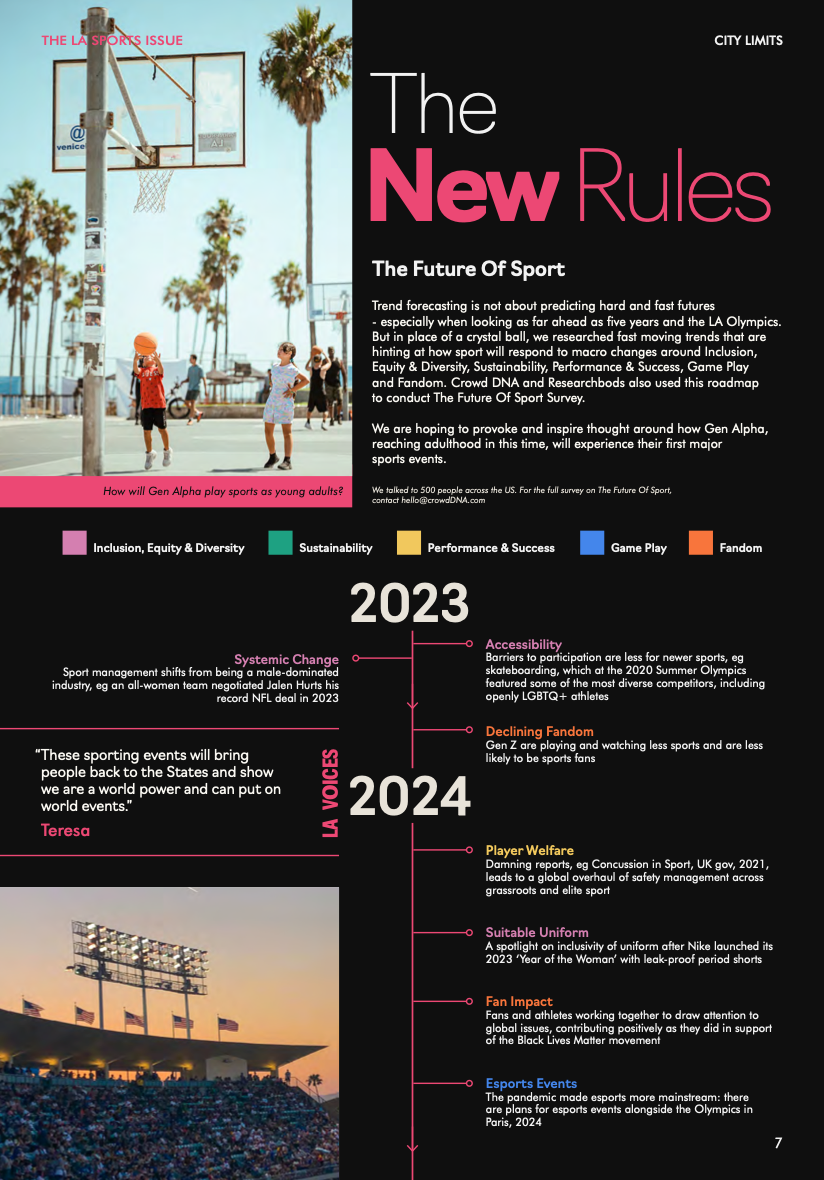
For the tenth issue of City Limits – Crowd DNA’s ongoing exploration of the urban experience – we’re exploring sport as another lens to focus on city culture (read previous issues on themes such as mobility and the night economy here). But this time, things are a little different, as we turn our focus onto a single city for once. With the men’s World Cup in 2026 and the Olympic and Paralympic games in 2028 both taking place in LA, the city is uniquely placed to showcase sport today – and forecast how it could look next in our ever-evolving cities.
These are going to be the first global sports events that Gen Alphas experience as young adults, and the world’s entertainment capital will surely know how to get their attention. Our City Limits reports on how preparations are taking place for this, and what it could look like both off-pitch and on…
p5 Semiotic analysis of event logosp3 A roadmap of sport in LAp7-9 The Future Of Sport
The City Limits LA Sports issue combines Crowd DNA’s new research on the Future Of Sport with talking to people on the ground across the city itself, as well as looking at issues like the impact of big events for marginalized urban communities, and brand initiatives during big sports events.
The full 13-page report includes:
_27 emerging trends in sport
_We talked to 500 people across the US for a full survey on the Future Of Sport
_The conversations about sporting events impact on a city and its community
_A semiotic analysis of what event design reveals about action off the field
_LA right now as Angelenos speak up about what matters to them
Crowd DNA’s Tom Meadows on the tools to conduct research that engages people who might think, feel, move or communicate differently
With diversity, equity and inclusion more on the agenda, within that market research has started tuning into accessibility for people with disabilities. It’s something we talk about a lot more. Our job is not just about speaking to people, asking questions, and completing activities. It’s about making sure all of those things are done within an environment that’s comfortable and empowering.
When we design our project set-ups, it’s to make people feel at ease to get the widest range of experiences. So when it comes to working with people with accessibility needs, this means we have to look at what deliberate steps we can take, to design fieldwork so they are properly included, and can contribute their opinions.
Being disability confident takes time, but what we are learning from talking to participants is helping us create more approaches. We will keep taking the steps to make sure everyone can engage and give their honest insights in a research setting.
Here are five learnings that help our disability-inclusive approach…
1.With additional needs, there’s no need to guess. Just ask
Running inclusive fieldwork is certainly not a one size fits all approach, and it can be counterintuitive to assume so. Any extra considerations someone needs to allow them to fully express themselves, and feel comfortable doing so, shouldn’t be an afterthought, but a foundational building block in our fieldwork planning. Hindsight is fantastic for so many things, but don’t use it to retrofit accessibility needs into a fieldwork plan you feel is already complete.
2. Initial clarity goes a long way to ease anxieties
Taking five minutes out of your day to give someone a call, or drop them a text to walk them through what the interview involves, how many people will be there, and what their role will be goes a long way – trust us. To be able to come along to an interview feeling informed, with no sudden surprises ensures we’ve got the perfect environment for fieldwork. Lead with the consideration you’d expect for yourself, and the insights will thank you for it.
3. Try your best not to ‘other’
Even before fieldwork, look at how you design your sample. It’s crucial not to isolate participants with accessibility requirements or make them feel like outsiders. While separate groups or interviews are sometimes a good option, don’t assume that additional needs automatically need to be grouped together and generalised. The brands we work with want to foster a sense of belonging, being part of a community. So let’s carry the same values when we’re speaking to consumers.
4. Bring it all together in the fieldwork itself
Everything we’ve said up until this point is fantastic, but only if it shows up during interviews. Take everything you’ve learned from speaking to participants, implement all of the considerations that you’ve asked them for. Remember any tweaks you might’ve made to a discussion guide or activity to make sure everyone can contribute. Have the confidence to encourage participants who might still be a little uncomfortable in market research environments, and make sure everything is in place for them to do so. Ultimately, lead with kindness and understanding.
5. Reflect and share
As we mentioned at the beginning, we acknowledge this is very much a work in progress. But that progress needs to be intentional. Set some time aside to look back over your fieldwork and ask what went well and where it could’ve perhaps been improved. Make sure your experience doesn’t stop with you, keep the conversation going and equip the rest of your team with the invaluable knowledge you’ve picked up.
If you’d like to hear more of our thoughts on accessibility in research, please get in touch: hello@crowdDNA.com
Modern luxury is on a mission to channel and enhance our personal wellbeing journeys. Crowd DNA’s Celine Longden-Naufal and DrJennifer Simon decode how one luxury brand transforms these desires into reality…
Many of us are turning to spirituality to cope with uncertainty, distrust and disenchantment with what makes us happy. Traditionally, luxury wellness brands have positioned themselves as the oracles between consumers and ‘spiritual’ experiences that go beyond the ordinary. Such brands offer pseudo-scientific insights, such as astrology and tarot readings, often prescribing curated ways to see, think and feel to regain a sense of order.
However, modern luxury consumers are beginning to create their own realities. They’re looking to explore and be inspired by a range of influences: from the mysterious potential of posthumanism, science and technology, to the sacred rituals of the past to ignite their own personal spiritual transformation.
Vyrao, a wellbeing brand that fuses energetic healing with perfumery, represents this shift to more profound personal and interpersonal journeys. By positioning themselves as portals rather than oracles, brands like Vyrao are opening new dimensions and offering novel, fluid and exciting ways to create a life we want to live, rather than being bestowed a predetermined fate from above.
By uncovering three semiotic codes – and how they’re grounded in wider culture – we explore how Vyrao is elevating luxury wellbeing by taking consumers beyond the limits of their imagination to unlock their inner magic.
1. Luxury As Ethereal Transportation
As the craving for personal transcendence grows, luxury brands are paving the way for wellness experiences that extend the imagination. A term often associated with the paranormal, Vyrao’s reference to ‘stimulating the sixth sense’ gently invites consumers to engage with the unexplored, while visuals of avatars mapping energy onto the human body bring attention to our qualities beyond the humanly physical, coding luxury as awakening a novel entity within us.
Vyrao uses metaphysical visuals to code luxury wellbeing as awakening a novel entity within us
Vyrao’s use of purples and blues evoke dreamscapes and mysticism, setting the scene for imaginative stimulation. Humanoid figures peeking through planetary shadows suggest AI generated alien beings, whereas visuals that resemble humans floating in outer space suggest alluring, but approachable otherworldly transportation, portraying luxury as pushing earthly boundaries so we can explore the unknown.
By tapping into the exciting aura of the extra-terrestrial and metaphysical, Vyrao is challenging our more prescriptive perceptions of spiritual wellness by positioning itself as a portal able to transport us there.
2. Luxury As Soulful Transformation
While luxury’s traditional approach to wellness has often been fuelled by insularity and fixed conventions, brands are now connecting to experiences of synchronicity, flow and oneness to authentically uplift and transform.
Sacred rituals and emotional connections point to luxury as a catalyst for self-determined transformation
Empowering statements such as ‘I am Magnetic’ ignite command over one’s own ability to allure through a powerful and inexplicable force. Visuals of women pressing their foreheads against each other resemble the warmth and connection associated with women’s circles, facilitating spaces to emotionally and spiritually connect, share and empower, coding luxury as unlocking the potential for meaningful impact.
Swirling mists circling porcelain vessels and candles connote the ceremonial tools used for sacred rituals, coding luxury as a catalyst for self-determined transformation. These almost shaman-esque qualities shift luxury from its impersonal, opulent reputation to a warmer, human connection to the soul, the earth and the sacred.
3. Luxury As Modern Alchemy
Today, luxury brands are establishing themselves as the ultimate portal by embracing new influences while celebrating the knowledge of the past.
Vyrao’s version of luxury wellbeing is one rooted in age-old wisdom infused with scientific precision
The juxtaposition of earthy, geological materials and smooth, white porcelain vessels resemble the tools used in alchemy such as pestle and mortars, suggesting the continuation of ancient practices.However, emphasis on blue and silver colour schemes recalls pharmaceutical comms, evoking a sense of clinical efficiency. When this is paired with chrome materials and glossy liquid drops similar to the alchemical practice of melting precious metals, it suggests a preservation of age-old understanding that has evolved with scientific precision.
Through this fusion of science and spirituality, Vyrao codes luxury wellbeing as transporting consumers on a magical journey to both the past and the future by optimising the mystery of age-old wisdom in conjunction with future-facing innovation to ensure enduring quality.
As demonstrated by Vyrao, modern luxury brands are updating our perceptions of spirituality and wellness. What is considered meaningful and sacred can come to life through novel synchronisations of ancient rituals and future-facing visions to resonate with today’s consumer. Like a magician, Vyrao’s hypnotic and ethereal storytelling creates a new dimension of luxury wellness that is able to manifest desires into reality.
Want to talk more about the new codes of luxury? Get in touch at: hello@crowdDNA.com
Thurs October 5 at 1pm & 5pm BST/ 12pm & 5pm EST. RSVP by clicking the first session here and the second session here.
Everything’s A Mess... a webinar on how brands can navigate uncertainty
As you may have noticed, it’s been a turbulent few years. Shocks of uncertainty feel like they’re coming more seismically and frequently than ever (though, spoiler alert: things have always been uncertain) leaving us, and brands, and consumers in a constant state of flux.
But it isn’t all doom and gloom. There is good to come from uncertainty, and in chaos lies opportunity. So, how can you find a way through?
What should brands do or not do? Are you a hand holder, facilitator of escapism, or relatable realist – and what’s right for your brand?
At Crowd DNA we’re all about embracing the messiness of culture. It’s where we think brands can really thrive, and we relish our role as specialists in navigating unknowns. In this webinar we’ll:
_Discover how uncertainty can be a motivator for both consumers and brands
_Explore the human needs that are heightened in response to instability
_Use our trends and semiotics expertise to provide guidance on how brands can speak to these needs, across visuals, language and more
Join Rachel Rapp, futures director, and Amy Nicholson, associate director, futures, on Thurs October 5 to get stuck into the mess.
RSVP by clicking 1pm BST / 8am EST here and 5pm / 12pm EST here.
In our latest issue of City Limits – our regular exploration of changing urban experience – we look at how heritage and change rub up against each other. One of our spotlights was on how Singapore’s hawker food is fighting to survive as well as innovate.
Like many cities in the world, change has never been alien to Singapore. While Singaporeans have become rather desensitised to the speed of change, there’s one thing they are reluctant to see change in at all – and that’s hawker food. What started out in the 1800s as scrappy and unorganised street food sold by migrants, hawker food has since morphed into open-air hubs located at the heart of everyday life. Established hawker centres were built in the 1970s to formalise the cuisine.
Here in the bustling outdoor courts, locals and tourists get good, affordable food. Joining queues for flavorful Singaporean specialities and Michelin-star dishes for under $10 (like the signature noodles with minced pork at Hill Street Tai Hwa Pork Noodle stall) is an unmissable feature of the city’s culture and identity. Hawker food has become part of the furniture – and it’s perhaps unsurprising that Singaporeans tend to be highly protective of it.
Locals and tourists flock to the Hawker centres around Singapore to taste amazing food at everyday prices
But there’s been a real fear in recent years that hawker food is on the brink of disappearing due to factors like an ageing population, unattractive working conditions and the pandemic. The 2020 UNESCO inscription (that commits Singapore to protecting and promoting it to future generations) was thought to be a lifeline to the trade, but some argue this was a red-herring route to go down. While nostalgia is a strong driver behind the survival of traditions, the fixation with the past can sometimes do more harm than good.
In the case of hawker food, we can see that nostalgia is laced with complex socio-cultural expectations and generational differences. It traps Singapore’s hawker food in the past and threatens its future.
“Omg, my chicken rice is now 20 cents more.”
Hawker food is expected to never cross the invisible boundaries of class. Low prices over the decades have created an ingrained perception that it’s less ‘atas’ (Singlish for sophisticated and high class) and should always remain so. Increases in prices can create a feeling that it might be more ‘worth it’ to eat at a restaurant (ironic as most hawker dishes today still come under $6 while restaurants and international franchises are $15-25). Social expectation around price severely hampers its survival amidst inflation, with the immense challenge of being forced to remain ‘low class’ with low prices while maintaining a profit.
TikTok creators champion Singapore’s hawker food stalls with both celebratory videos and content to highlight the issues that are facing the chefs to survive in today’s tough economy
“This one doesn’t taste original.”
Apart from price, there’s also an expectation for hawker food to remain unchanged in form and flavour to live up to the concept of ‘authenticity’ – as if it’s a timeless artefact. Changes in operation – from simplifying preparation methods to handing down to ‘the kid’ – are often met with uncertainty, cynicism and fear that the ‘authentic flavour’ will be lost. Meanwhile, younger hawkers who choose to venture out (eg with fusion food) receive little recognition as a part of the city’s hawker culture simply because they are not ‘traditional’. Again, the intense nostalgia surrounding hawker culture is preventing any type of innovation.
So what’s the way forward for Singapore’s hawkers stuck in a nostalgia trap? Of course, nostalgia is still crucial to the survival of traditions. But in the case of hawker food, it has made definitions too narrow to accommodate new joiners into the scene. This in turn threatens preservation. Cities change, tastes change. Accepting this will keep hawkers filling our bellies for decades to come.
As people get to their fifties and sixties, they talk about how they experience ageism – at work, on a billboard, in culture. Our report, focussing on the APAC region, uses the Four Is – Irrelevance, Inferiority, Infantilization and Invisibility – to describe what this feels like. But these experiences are now being roundly rejected. We wanted to look at the people who are growing older but arriving at a life stage and feeling like it actually has so much potential in all areas.
Reframing Ageing researches the ‘rejecting, reassessing, reclaiming’ of ageing that’s taking place. We use cultural cues, research and talking to our KIN members across APAC – Crowd DNA’s global network of creators and connectors – to show what we can learn about the needs of the 50-plus person and what they want when ageing is reframed….
The Reframing Ageing report introduces the 50-plus person who is completing extreme marathons, starting new businesses, or enjoying edgy fashion (as well as grey hair and going to the doctor more often). These shifting attitudes to ageing make opportunities for new products, media targeting or user images.
The full 35 page report includes:
_Insight on how it feels to experience ageism and where it can alienate customers
_Three emerging trends in ageing: Rejecting ageing – Reassessing ageing, and Reclaiming ageing
_Interviews with our KIN network about ageing positivity
_Spotlight on what we can learn for products and brands
_Data on how the culture around ageing effects people in work and well-being
Crowd Shortcuts – a quick chat about something that’s caught our attention. This week, how the fashion for clothes that shroud or reshape give confidence to take up space in the world…
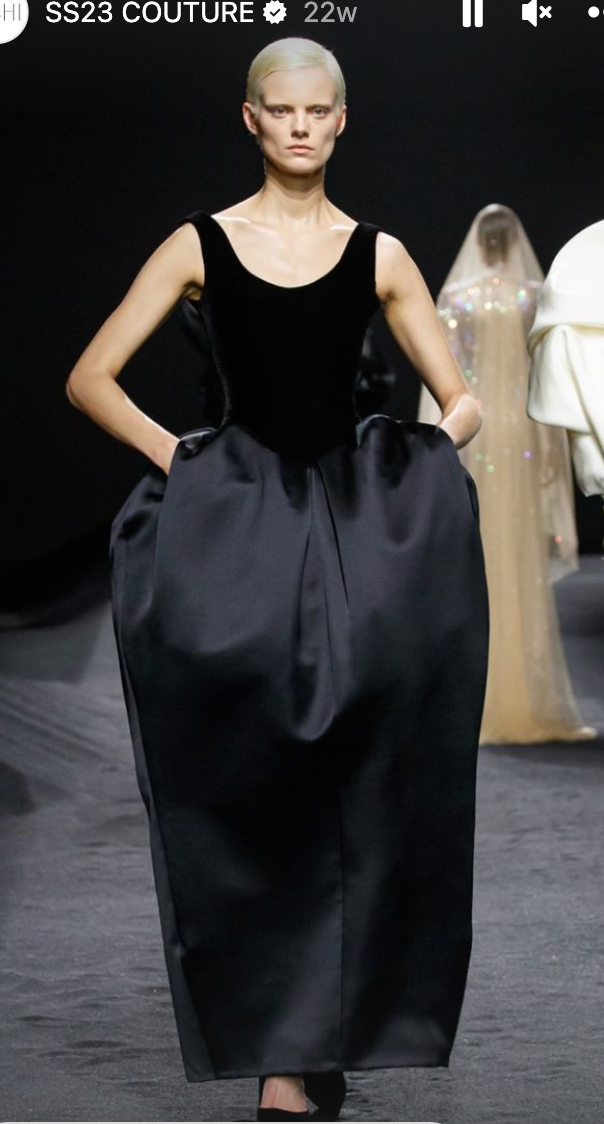
What’s all this then? This summer, Kanye West took girlfriend Bianca Censori to church, with her concealed by a cushioned wall encircling her neck and black fabric that stretched all the way over her head and torso with no arm holes or sleeves. Also seeking clothing for concealment at a blockbuster premiere, actress Hayley Atwell hid half her body in oversized-plus trousers by Ashi Studio – opting out of the red carpet norm for female actors. Meanwhile weeks earlier, at London’s fashion week, models had their necks and ankles covered up by super voluminous ruffles, and wore big brooches that were more armour than accessory.
Finally, a stylish alternative to the kaftan! Yes, these clothes look pretty darn cool. But more than that – and yes, even more importantly – these cover-ups will administer safety. They are clothes that give anonymity, or they rebuff the male gaze, or literally allow the wearer to take up more space – actions desired by celebs and people in everyday life alike.
A cover-up? Sounds like the opposite of the bodycon trend… Not at all, and that’s what makes this so exciting. The original bodycon clothing equalled women being tightly stitched into their dress to experience the suffocating grip of passing as skinny and hot. But these clothes arestill look-at-me fashion like the bodycon dresses that clung to every line of the figure. Yet it’s moved on to reflect our current needs: clothes that provide service to the wearer (safety, or space) as well as body confidence that is no longer predicated on binaries like fat or thin, small or large.
@richardquinn on Instagram, London fashion week@harrion Instagram, inflatable trousers @ashistudio on Instagram, bulbous shapesThe new body-con on the catwalk
Stylish clothes serving up body confidence for more of us? We like… And there’s more. Let’s look at how pop star Sam Smith doesn’t let their gender identity be reduced to choice of clothing by embracing this new bodycon trend. At the Brit music awards earlier this year, their outfit by HARRI featured a high neck, inflated arms and legs and a zip-up design over the chest – mocking the traditional concepts of couture that flaunt the perfect shape of the body. Embracing sculptural clothes was a way for them to comprehensively present their identity as not narrowly defined, as fluid, as a new shape entirely.
Body and soul confidence, then… and clothes helping us to have the space for that exploration is quite a cultural moment. Holding space and…
… literally giving space… You’ve got it. In our post-pandemic world it is also quite handy to have a large floral accessory that both serves looking stylish and makes people stand some distance from you.
TL;DR: What to wear has always been a dance between personal expression and the need to pass in the world at large. This new body-con enables both: to be confident about your expression of self in clothes, and feel safe doing so. It takes the body-conditioning – that we all need to look a certain way – out of body-con. And that’s true body confidence for all.
Plant-based foods are now tasty to all – even avid meat-eaters. Crowd DNA’s Céline Longden-Naufal decodes how this happens by countering veganism’s sombre reputation with playful pleasure…
An avid meat eater chooses a beefless burger. A shopper picks Beyond Meat sausages with no thought to animal welfare. Or a vegan dish is ordered by someone who has no rules about what they can or can’t eat. For those who enjoy plant based not as a strict choice, or a way of life, how do these products appeal to this less rigid person?
As part of our regular cultural decode series, we analyse how La Vie (a plant-based bacon and lardon alternative product) does this by fostering a more playful and approachable attitude to plant-based diets. We look at how it engages with the flexible consumer, to “unite everyone at the same table, no matter their dietary preferences,” as La Vie co-founder Nicholas Schweitzer puts it. And how this hybrid market is being created without severing the important ties to the environmental considerations and ethics that are the historic (and still beating) heart of the veganism movement.
1. Plant-based as playful pleasure
Child-like wonder evoked by playful graphics
La Vie’s use of bright, clashing block colours to amplify the hand-drawn illustrations of anthropomorphised characters recall children’s cartoons, coding the plant-based world as bringing a child-like wonder to what has traditionally been seen as a sombre subject. This marries well with a cheeky and down-to-earth tone of voice (eg “Made from plants, not from ass!”) that suggests engagement with a grown-up audience, communicating an adult playfulness. It sparks our childhood imaginative freedom and puts it through the lens of age appropriate wit. Meanwhile, the dynamism and eccentricity of those cartoons elevates the plant-based ethos in more energetic and stimulating ways –all in all, La Vie is positioned as an uplifting and pleasurable indulgence for all ages.
2.Plant-based as light-heartedly rebellious
Making serious points in a non-serious way
While the switch to plant-based diets are usually stemmed from deep-rooted ethical, health and environmental issues, these are often fuelled by aggression and bleakness. La Vie’s use of relevant puns (eg “Bacon that doesn’t make the planet sizzle”) brings light and humour to important issues around sustainability and health. Playing with brand’s cultural stereotype to push plant-based products – like “Ze award-winning French plant-based bacon now available in Sonzburries” – also codes this space as pushing boundaries without taking itself too seriously. We often see in millennial humour used to convey realism with topics that are considered serious. Imagery of counterculture symbols (eg planet earth giving the peace sign) connotes a 1970s hippie aesthetic, coding plant-based as being an optimistic steward of the environment and ethics, rather than the bringer of doom and gloom.
3. Plant-based as approachable and flexible
Recognisable routines and cultural tropes make the innovative product feel familiar
Traditionally, vegans have been the primary focus for plant-based products where the vegan credentials of a product took priority over being a tasty. The visuals of dishes that incorporate non-vegan components (eg eggs) code plant-based lifestyles as expansive and adaptable. Imagery of full, brightly colourful dishes and glistening ingredients resemble the images we see on diner menus that are known for rich foods, and suggests that plant-based lifestyles can also be tantalising and indulgent. Meanwhile, with breakfast being an integral part of family life, utilising this uniting symbol of a comforting routine evokes approachability. And the use of familiar pop culture references (eg “On Mondays we wear pink” – from Mean Girls) and inclusive language (eg “For meat lovers and vegans”) makes this space accessible for everyone.
Plant-based brands are continuously striving for new and creative ways to entice consumers to veganism without losing their traditional customers. Introducing a whimsical playfulness and light-hearted activism rather than the historical scare-mongering tactics allows others to ease into plant-based options without eating it with a side order of guilt.
La Vie champions these shifts without compromising on indulgence and taste to transport consumers to a novel yet familiar plant-based world. It allows them to rethink their engagement with health and planet without leaving a bad taste in their mouth.