Club Free Launch

Club Free Issue One, download it here.

A bold claim, but we’re going with it. We’re taking Freedom back – celebrating manifestations of it that are about community and shared responsibility rather than purely self-interest.

This editorial insights series will share the many positive and motivating stories emerging from people getting to live their lives just how they want to live them (and therefore more brands needing to move on from squeezing people into old fashioned little boxes).

Chapter One, The Poly-Normals & Chapter Two, The Financial Outsiders

First up in Club Free, issue one, The Poly-Normals and The Financial Outsiders. The former: a set of people changing sexual relationships for the better, for all; the latter: an equally community-minded group living and giving outside of elitist money systems. Brought together: clear signals of just how far and wide our Club Free adventures can take us.

The two chapter report includes: 

_Introduction to the shared culture of this new freedom: embracing community, contribution and shared responsibility

_Spotlight on what brands can learn from this 

_Sharing the stories of people who are getting freedom back on track.

We hope you find these stories interesting and inspiring. And please do feel (yes) free to reach out to the Crowd DNA team to explore how this type of thinking could apply to your brand challenges. 

Club Free Issue One, download it here.

Though this is issue one, we in fact trialled some freedom material in a rather good webinar last summer – you can download our Reframing Ageing APAC and Un-Dependents reports here and here


What’s all this then? We’ve had #GutTok (over 800 million views) and posting a stool sample to a nutrition app for analysis. Now comes the next big branding of bodily functions: the drive to tap menstrual blood as a valuable health resource. 

Has ‘period positivity’ come this far? Yes. Content creator wild.witchy.woman (26.9 followers on TikTok) is among the advocates for actually drinking menses for optimum well-being… Meanwhile, healthcare start-ups are capitalising on this with research into the medical value of menstrual effluence (which contains blood, vaginal secretions, cervical mucus, and endometrial cells), and demonstrating its value to a consumer.

Tell us more… Theblood (www.theblood.io) offer a kit that will give insights into individual menstrual cycles from a sample, and can be studied for conditions such as endometriosis. Founders Isabelle Guenou and Miriam Santer believe: “Menstruation can be the answer to problems and pain”. Meanwhile, Qvin™  has designed the Q-Pad (qvin.com) for the supply of a sample of menstrual blood that can be then tested for critical health information like biomarkers for diabetes. 

So why is this ‘waste’ product being re-valued now? It’s time to take the female body seriously – all of it and especially the bits greeted with disgust. Healthcare services are being called out for failing to do so; from ‘medical gaslighting’ to blaming terminology (eg, ‘geriatric mother’; ‘hostile uterus’) and the so-called Gender Data Gap where treatments efficacy may only have been tested on male bodies. 

It’s a long way from hiding tampons up sleeves… Absolutely. To have the option of giving a blood sample that is not only for research into overlooked health issues, but taken from a bodily process often treated with unease by medical professionals (or much worse) is empowering. As one of the participants in a Qvin™ study to assess if menstrual blood can be used to screen for cervical cancer put it: “For me, it’s just a win overall if this becomes a product because it will reduce my anxiety and will give me more control over what’s going on with the testing.”

And let’s not underestimate how this research is needed: Note, in a recent review of scientific papers, Leah Hazard finds that there are about four hundred studies on menstrual effluent compared with more than fifteen thousand for semen or sperm (Womb, published 2023).

Where else is this health empowerment happening? Plugging the data gap on hormones, individuals track their cycles – to then sync to exercise, diet, skincare, mood or productivity (and yes, bypass a visit to the docs altogether and download one of the many apps to get personalised insights). There’s more and more options like this for people to choose – and therefore control – the process of tracking their health themselves. 

TL;DR: While looking at periods with wonder may have happened because people feel let down by traditional medicine, it has forced new insights, research and empowered attitudes to health. So the opposite of waste – thankfully. 

Semiotics At Crowd: Feeld

We know today’s daters are tired of the ‘self-imposed pressure for conventional labels’ (Tinder, 2023) and many seek the freedom to define their own relationships. They are wanting an invitation to self exploration and freedom to seek out a bit more of what they fancy.

And this more intentional approach to romantic life is reshaping dating culture – and of course, dating apps. It can even be a direct antidote to the downsides of dating app culture (ie the 35 percent who experience unwanted sexual images, or the 80 percent exposed to emotional burnout, Pew 2020; Singles Report 2023). 

While it’s something that Tinder and Hinge have recognised by adding open relationships to profile options, dating app Feeld is leading the way (not least by referring to daters as ‘humans’). Below is our semiotic analysis of the Feeld brand to show what this reshaped dating culture looks and sounds like…

Heightened Intimacy 

Visuals of gentle skin-to-skin embrace suggests touch is used as a means of intimate discovery, and a level of trust and support. Warm colour palettes and references to physical softness (foliage and nature, hazy images) creates an approachable space. Meanwhile, imagery of people smiling and mutually embracing each other evokes a feeling of closeness and deep connection. By coding Feeld as facilitating intimate depth that goes beyond carnal lust, dating culture can explore the possibilities of more meaningful relationships.

Authentic Connections

Introducing a new wave of daters who are ‘experimental’, Feeld signals a dating culture that’s abandoning tradition. While other mainstream apps use the term ‘preferences’, that can often make dating feel like you’re headhunting a mate, Feeld instead uses the term ‘desires’ . This reestablishes the priority of pleasure and joy in dating. We’re also seeing unposed visuals of diverse couples passionately and full heartedly engaging with each other in private spaces, as well as documentation of personal stories, evoking a feeling of trust and honesty not only between connections, but among a like minded community. In all, Feeld is a safe place to explore an inclusive and authentic approach to dating.

Encouraged Exploration

The app positions itself as always in a “dialogue” with its users. It uses open language with a comforting tone of voice when addressing ‘taboo topics’, similar to a teacher-like quality of benevolent guidance, enlightening daters about the spectrum of intimacy. We also see visuals that evoke a feeling of being welcomed –  boards that encourage users to “come on in” resemble signage we’d see outside of spaces of hospitality, ensuring that there’s a place at the table for everyone to explore and to truly “Find Your People”.

Through very careful and thoughtful use of imagery and words, Feeld reveals a whole-hearted commitment to showing how using dating apps can be a safe, inclusive and most importantly, joyful, experience. In this light, it’s doing even more than reshaping dating culture, it’s showing how we can reshape how we connect as humans.

If you’d like to learn more about how we use semiotics to reach real cultural insights, get in touch at: hello@crowdDNA.com

What’s all this then? People, we don’t have to take a clean, pristine and pure approach to life — dirt, grime, mess, and mud are being accepted as a new (likely to be rusty) gold standard.

Phew! No more wipeable sofa cushions! So where are messy aesthetics being celebrated? They’ve moved on from just a social media-fueled shock tactic as people have grown desensitised to yuckiness. Now mess and dirt are making an impact by appearing in everyday, big ticket pleasures. 

Tell me more… There’s a lot of mud being thrown in high fashion — think Elena Velez models and mud wrestles on the runway, or Kylie Jenner’s recent Acne Studios campaign clothed in thousand dollar garments and splatters of mud. We’ve also seen the return of the moto and rain boot, and also niche creations like Crocs’ new Shrek-themed shoes (“get out of my swamp!”-core).

How else is messy realities making an impact? Meanwhile, on social media you’ve probably noticed the dirty/messy trend. Think: glass tubs filled with paint being rolled down stairs for ASMR videos, or wine bottles being thrown into walls. And if you can bear to watch it, there’s the ‘is it cake’ trend’s viral older sister — the zit popping cake and the bloody cake smash trend.

Ok, give me the dirt on dirt – what’s really going on here? It’s way more than just surface level spillage. It’s a manifestation of our collective desire to embrace imperfections and chaos in an overly curated world. It’s how Kylie appears with a dirty double of herself in the Acne Studios advert, signalling that this aesthetic is an acknowledgement that we all – yes, even the supremely manufactured Kardashians – have a good and messy side…

So no more clean fun? The world is literally boiling and the clean movement just didn’t seem to capture the overall dirtiness of how people have been feeling. We’re living with dirty realities all around us, and there’s a collective sigh of relief in being honest about it.

TL;DR: As the earth boils and the ground muddifies, everyone and everything is welcome in this swamp! 

In our latest issue of City Limits we head to Los Angeles as the city prepares to host two of the world’s biggest sports events in the next five years…

City Limits Volume 10 – download it here

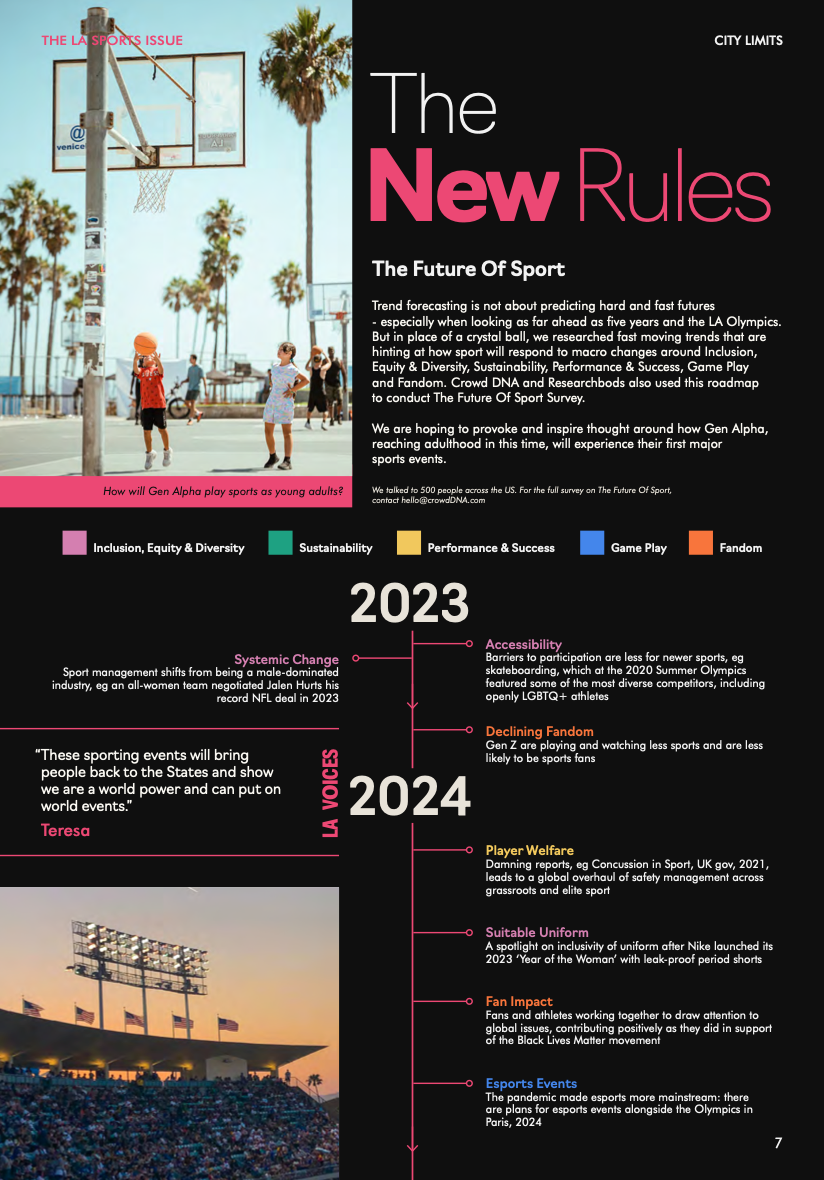
For the tenth issue of City Limits – Crowd DNA’s ongoing exploration of the urban experience – we’re exploring sport as another lens to focus on city culture (read previous issues on themes such as mobility and the night economy here). But this time, things are a little different, as we turn our focus onto a single city for once. With the men’s World Cup in 2026 and the Olympic and Paralympic games in 2028 both taking place in LA, the city is uniquely placed to showcase sport today – and forecast how it could look next in our ever-evolving cities. 

These are going to be the first global sports events that Gen Alphas experience as young adults, and the world’s entertainment capital will surely know how to get their attention. Our City Limits reports on how preparations are taking place for this, and what it could look like both off-pitch and on…

The City Limits LA Sports issue combines Crowd DNA’s new research on the Future Of Sport with talking to people on the ground across the city itself, as well as looking at issues like the impact of big events for marginalized urban communities, and brand initiatives during big sports events.

The full 13-page report includes:

_27 emerging trends in sport

_We talked to 500 people across the US for a full survey on the Future Of Sport 

_The conversations about sporting events impact on a city and its community

_A semiotic analysis of what event design reveals about action off the field

_LA right now as Angelenos speak up about what matters to them

City Limits Volume 10: download it here 

Thurs October 5 at 1pm & 5pm BST / 12pm & 5pm EST. RSVP by clicking the first session here and the second session here.

Everything’s A Mess... a webinar on how brands can navigate uncertainty 


As you may have noticed, it’s been a turbulent few years. Shocks of uncertainty feel like they’re coming more seismically and frequently than ever (though, spoiler alert: things have always been uncertain) leaving us, and brands, and consumers in a constant state of flux. 

But it isn’t all doom and gloom. There is good to come from uncertainty, and in chaos lies opportunity. So, how can you find a way through? 

What should brands do or not do? Are you a hand holder, facilitator of escapism, or relatable realist – and what’s right for your brand?


At Crowd DNA we’re all about embracing the messiness of culture. It’s where we think brands can really thrive, and we relish our role as specialists in navigating unknowns. In this webinar we’ll:

_Discover how uncertainty can be a motivator for both consumers and brands

_Explore the human needs that are heightened in response to instability

_Use our trends and semiotics expertise to provide guidance on how brands can speak to these needs, across visuals, language and more


Join Rachel Rapp, futures director, and Amy Nicholson, associate director, futures, on Thurs October 5 to get stuck into the mess.

RSVP by clicking 1pm BST / 8am EST here and 5pm / 12pm EST here.

Reframing Ageing: APAC

The older adult category is stuck in time. Our new report shows how to get in step with today’s 50-plus people who are passionately reframing ageing…

Reframing Ageing: APAC download it here.

As people get to their fifties and sixties, they talk about how they experience ageism – at work, on a billboard, in culture. Our report, focussing on the APAC region, uses the Four Is – Irrelevance, Inferiority, Infantilization and Invisibility – to describe what this feels like. But these experiences are now being roundly rejected. We wanted to look at the people who are growing older but arriving at a life stage and feeling like it actually has so much potential in all areas. 

Reframing Ageing researches the ‘rejecting, reassessing, reclaiming’ of ageing that’s taking place. We use cultural cues, research and talking to our KIN members across APAC – Crowd DNA’s global network of creators and connectors – to show what we can learn about the needs of the 50-plus person and what they want when ageing is reframed….

The Reframing Ageing report introduces the 50-plus person who is completing extreme marathons, starting new businesses, or enjoying edgy fashion (as well as grey hair and going to the doctor more often). These shifting attitudes to ageing make opportunities for new products, media targeting or user images.

The full 35 page report includes:

_Insight on how it feels to experience ageism and where it can alienate customers

_Three emerging trends in ageing: Rejecting ageing – Reassessing ageing, and Reclaiming ageing

_Interviews with our KIN network about ageing positivity 

_Spotlight on what we can learn for products and brands

_Data on how the culture around ageing effects people in work and well-being

Reframing Ageing: APAC download it here

Crowd Shortcuts – a quick chat about something that’s caught our attention. This week, how the fashion for clothes that shroud or reshape give confidence to take up space in the world…

What’s all this then? This summer, Kanye West took girlfriend Bianca Censori to church, with her concealed by a cushioned wall encircling her neck and black fabric that stretched all the way over her head and torso with no arm holes or sleeves. Also seeking clothing for concealment at a blockbuster premiere, actress Hayley Atwell hid half her body in oversized-plus trousers by Ashi Studio – opting out of the red carpet norm for female actors. Meanwhile weeks earlier, at London’s fashion week, models had their necks and ankles covered up by super voluminous ruffles, and wore big brooches that were more armour than accessory.

Finally, a stylish alternative to the kaftan! Yes, these clothes look pretty darn cool. But more than that – and yes, even more importantly – these cover-ups will administer safety. They are clothes that give anonymity, or they rebuff the male gaze, or literally allow the wearer to take up more space – actions desired by celebs and people in everyday life alike. 

A cover-up? Sounds like the opposite of the bodycon trend… Not at all, and that’s what makes this so exciting. The original bodycon clothing equalled women being tightly stitched into their dress to experience the suffocating grip of passing as skinny and hot. But these clothes are still look-at-me fashion like the bodycon dresses that clung to every line of the figure. Yet it’s moved on to reflect our current needs: clothes that provide service to the wearer (safety, or space) as well as body confidence that is no longer predicated on binaries like fat or thin, small or large. 

Stylish clothes serving up body confidence for more of us? We like… And there’s more. Let’s look at how pop star Sam Smith doesn’t let their gender identity be reduced to choice of clothing by embracing this new bodycon trend. At the Brit music awards earlier this year, their outfit by HARRI featured a high neck, inflated arms and legs and a zip-up design over the chest – mocking the traditional concepts of couture that flaunt the perfect shape of the body. Embracing sculptural clothes was a way for them to comprehensively present their identity as not narrowly defined, as fluid, as a new shape entirely.

Body and soul confidence, then… and clothes helping us to have the space for that exploration is quite a cultural moment. Holding space and…

… literally giving space… You’ve got it. In our post-pandemic world it is also quite handy to have a large floral accessory that both serves looking stylish and makes people stand some distance from you. 

TL;DR: What to wear has always been a dance between personal expression and the need to pass in the world at large. This new body-con enables both: to be confident about your expression of self in clothes, and feel safe doing so. It takes the body-conditioning – that we all need to look a certain way – out of body-con. And that’s true body confidence for all.